Why Most Landing Pages Fail Before They Even Launch
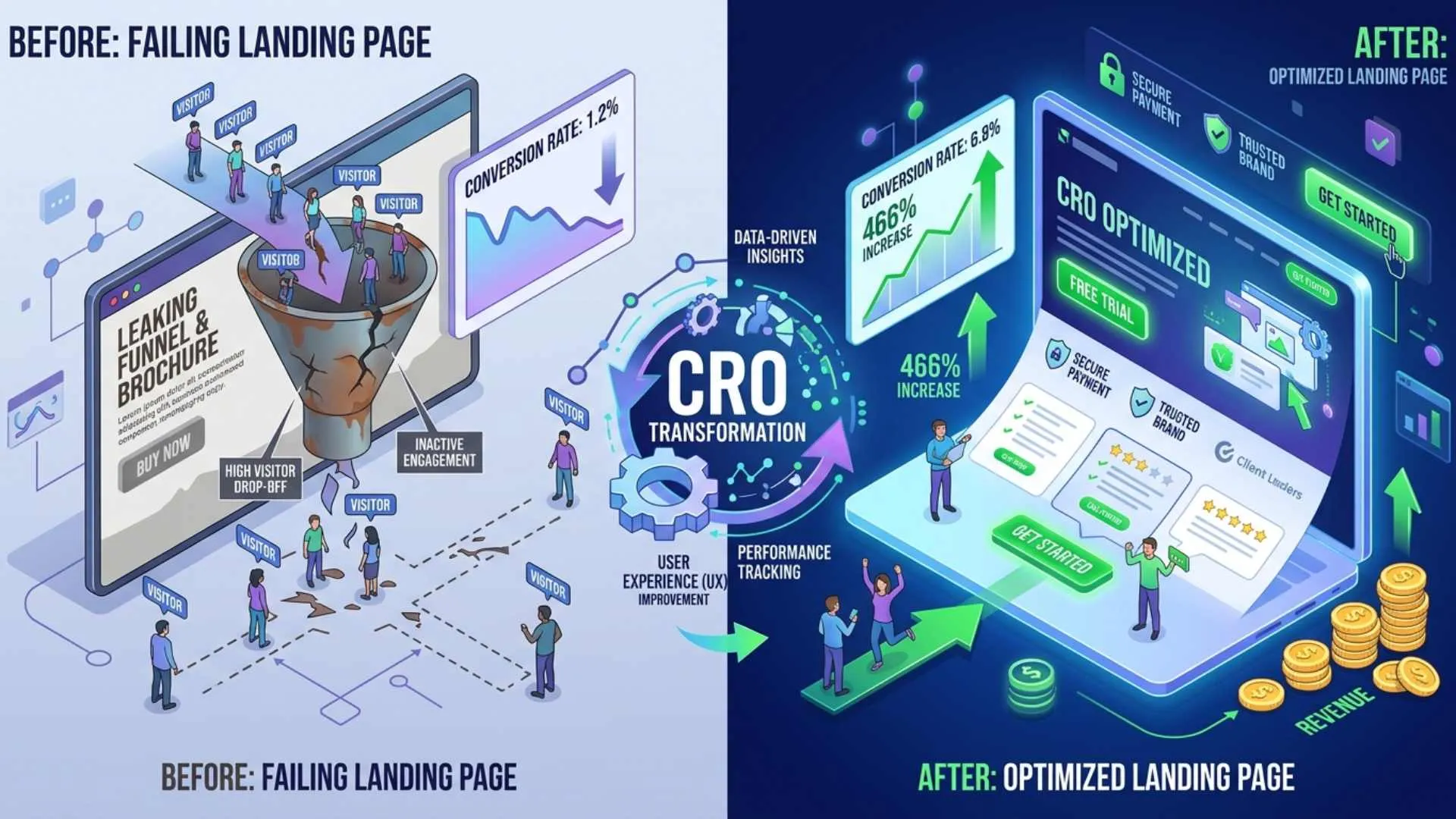
Every day, service businesses and local agencies spend good money driving traffic to their websites, only to watch visitors arrive, scroll for a few seconds, and leave without a trace. The problem is rarely the traffic itself. More often than not, the culprit is a landing page that was built to look nice instead of being built to convert. A beautiful page that nobody acts on is simply an expensive brochure.
Table of Contents
- Why Most Landing Pages Fail Before They Even Launch
- Understanding CRO and Why It Matters for Local Businesses
- The Anatomy of a High-Converting Landing Page
- A Single, Focused Goal
- A Compelling Above-the-Fold Experience
- Trust Signals Placed Strategically
- Core CRO Techniques That Actually Move the Needle
- Optimize Your Call to Action Buttons
- Reduce Friction in Your Forms
- Use Social Proof to Build Momentum
- Speed and Mobile Experience Are Non-Negotiable
- Match the Message to the Traffic Source
- Testing, Measuring, and Improving Over Time
- Turn Traffic Into Revenue
Landing pages are the workhorses of any digital campaign. Whether you are running Google Ads for a hotel, promoting a dental clinic, or generating leads for a local marketing agency, the page your visitors land on is where the money is either made or lost. This is where CRO (Conversion Rate Optimization) comes into play, and it is one of the most underrated skills in the entire digital marketing toolkit.
In this article, we will break down practical, field-tested CRO techniques that help service businesses and local agencies turn more visitors into leads, bookings, and paying customers. No fluff, no vague theory — just the tactics that consistently move the needle.
Understanding CRO and Why It Matters for Local Businesses
Conversion Rate Optimization is the practice of systematically improving your website so that a higher percentage of visitors take the action you want them to take. That action could be filling out a contact form, booking a room, requesting a quote, calling your phone number, or starting a live chat. The percentage of visitors who complete that action is your tasa de conversión, and it is the single most important number on any landing page.
Here is why CRO matters so much for local businesses and agencies. When you increase your conversion rate, you effectively reduce the cost of every lead you generate. If you are spending money on Google Ads and your landing page converts at 2%, doubling that rate to 4% cuts your cost per lead in half without spending an extra cent on traffic. That is the quiet superpower of CRO: it multiplies the value of everything else you are already doing.
For local agencies, CRO is also a powerful retention tool. Clients do not stay because their website looks modern. They stay because they see measurable results, and improving the tasa de conversión is one of the fastest ways to deliver those results.
The Anatomy of a High-Converting Landing Page
Before diving into individual tactics, it helps to understand what separates a landing page that converts from one that does not. High-converting pages tend to share a common structure, and every element on the page serves a clear purpose.
A Single, Focused Goal
The most common mistake is trying to do too much on one page. A landing page should have one primary goal. If you want people to book a call, do not also ask them to download an ebook, follow you on social media, and subscribe to a newsletter. Every additional option creates friction and dilutes the decision. One page, one goal, one clear next step.
A Compelling Above-the-Fold Experience
Visitors decide within seconds whether to stay or leave. Your headline, subheadline, hero image, and primary llamadas a la acción should all be visible without scrolling. The headline needs to speak directly to the visitor’s problem or desire, not to your company’s history. “Book Your Table in Under 60 Seconds” beats “Welcome to Our Restaurant” every single time.
Trust Signals Placed Strategically
Service businesses live and die by trust. Testimonials, reviews, star ratings, client logos, certifications, and guarantees all reduce perceived risk. Place them near your CTAs, not buried at the bottom of the page where nobody sees them. In local markets, mentioning your city or region in testimonials makes them significantly more powerful.
Core CRO Techniques That Actually Move the Needle
Optimize Your Call to Action Buttons
Your llamadas a la acción are the gateways to conversion, yet they are often treated as an afterthought. Button copy matters enormously. Generic phrases like “Submit” or “Learn More” create hesitation, while specific, action-oriented copy like “Get My Free Quote” or “Book My Room Now” tells visitors exactly what happens next. Use first-person language where it fits, make the button visually prominent with contrasting colors, and ensure it is large enough to tap comfortably on mobile devices.
Reduce Friction in Your Forms
Every field you add to a form reduces conversions. Ask yourself whether you truly need a visitor’s company size, budget, or address before you can help them. In most cases, a name, email or phone number, and a short message are enough to start the conversation. You can always gather more information later. Also, make sure your forms display validation errors clearly and never lose the visitor’s input if something goes wrong.
Use Social Proof to Build Momentum
People trust other people far more than they trust brands. Video testimonials, detailed case studies, and before-and-after results are especially powerful for service businesses. For local agencies, showing real numbers from real clients in the same industry or region creates an instant sense of relevance. Even simple elements like a “500+ happy customers” badge can nudge a hesitant visitor toward action.
Speed and Mobile Experience Are Non-Negotiable
A slow landing page kills conversions before they have a chance to happen. Google’s Core Web Vitals give you a clear framework for measuring page experience, and businesses that ignore them pay for it in lost leads. Compress your images, use modern image formats, minimize heavy scripts, and test your page on real mobile devices. For local businesses, mobile is often the majority of traffic, so a mobile-first mindset is essential.
Match the Message to the Traffic Source
If someone clicks an ad about “emergency plumbing in Austin,” they should land on a page that says exactly that. Message match between the ad, the keyword, and the landing page is one of the highest-impact CRO levers, and it costs nothing to implement. Mismatched expectations are a silent conversion killer.
Testing, Measuring, and Improving Over Time
CRO is not a one-time project. It is an ongoing process of testing, learning, and refining. Start by setting up proper tracking so you know exactly where visitors drop off. Tools like heatmaps, session recordings, and funnel reports reveal the friction points that analytics alone cannot show you.
From there, form hypotheses and run A/B tests on one element at a time. Test headlines, button colors, form lengths, testimonial placement, and page layouts. Not every test will win, but every test teaches you something about your audience. Over months, these small wins compound into a dramatically higher tasa de conversión.
It is also worth remembering that CRO and SEO work best together. A page that ranks well but converts poorly wastes its traffic, while a page that converts well but gets no traffic never reaches its potential. When you combine strong local SEO with disciplined CRO, you create a system where every visitor is more valuable.
Turn Traffic Into Revenue
Landing pages are not just design projects. They are revenue engines, and the difference between a page that converts at 2% and one that converts at 6% can transform the economics of your entire business. By focusing on a single goal, sharpening your llamadas a la acción, reducing friction, building trust, and testing relentlessly, you can turn more of your existing traffic into real customers without spending more on ads.
If you are a service business or a local agency and your landing pages are not pulling their weight, now is the time to act. Audit your highest-traffic pages, identify the biggest friction points, and start testing. Better yet, reach out to a CRO specialist who can help you build a system that consistently improves your tasa de conversión month after month. Your traffic is already there — make sure your landing pages are ready to convert it.